Showing posts with label 11th class. Show all posts

Saturday, 7 May 2016

Difference between mass and weight.


Mass is the measure of the amount of matter in a body. Mass is denoted using m or M.

Weight is the measure of the amount of force acting on a mass due to the acceleration due to gravity. Weight usually is denoted by W. Weight is mass multiplied by the acceleration of gravity.

Comparison of Mass and Weight

1)- Mass is a property of matter. The mass of an object is the same everywhere,
   - Weight depends on the effect of gravity. Weight varies according to location.

2)- Mass can never be zero.
    -Weight can be zero if no gravity acts upon an object, as at the center of earth(g = 0).

3)- Mass does not change according to location.
   - Weight increases or decreases with higher or lower gravity.

4)- Mass is a scalar quantity. It has magnitude.
   - Weight is a vector quantity. It has magnitude and is directed toward the center of the Earth or other gravity well.

5)- Mass may be measured using an ordinary balance.
   - Weight is measured using a spring balance.

6)- Mass usually is measured in grams and kilograms.
    - Weight often is measured in newtons, a unit of force.

Sunday, 9 August 2015

Magnus Effect (Curve path by spinning ball).

Magnus effect

The Magnus effect is the commonly observed effect in which a spinning ball curves away from its principal flight path.

The Magnus effect is a lift force of tremendous importance to all athletes who want to bend the flight of a ball.

Golfers, baseball pitchers, and soccer, tennis, and table tennis players all employ this effect to curve the flight path of the ball. The game of baseball in particular is made more fascinating by the Magnus effect.

The Magnus effect operates in the following manner.

As a spinning ball moves through the air, it spins a boundary layer of air that clings to its surface as it travels along. On one side of the ball the boundary layer of air collides with air passing by. The collision causes the air to decelerate, creating a high-pressure area. On the opposing side, the boundary layer is moving in the same direction as the air passing by, so there is no collision and the air collectively moves faster. This sets up a low-pressure area. The pressure differential, high on one side and low on the other, creates a lift force (the Magnus force) that causes the ball to move in the direction of the pressure differential (i.e., from high to low).

The Magnus effect can combine with the force of gravity or fight against gravity.

The Magnus effect can be applied in any direction, and in this way an athlete can create backspin, topspin, and sidespin. Soccer players are well known for the way they use “banana kicks” (i.e., the Magnus effect) to curve free kicks and corner kicks around defenders and into the goal mouth. Tennis players and volleyball players use the Magnus effect when they apply topspin to make the ball drop suddenly while in flight.

Saturday, 8 August 2015

Why windows explode, rather than implode in hurricanes?

Bernouilli's principle tells us why windows tend to explode, rather than implode in hurricanes: the very high speed of the air just outside the window causes the pressure just outside to be much less than the pressure inside, where the air is still. The difference in force pushes the windows outward, and hence explode. If you know that a hurricane is coming it is therefore better to open as many windows as possible, to equalize the pressure inside and out.

Heart attack and Bernoulli's principle.

Blood Flow and Heart Attack

Bernoulli’s principle says that the sum of potential,kinetic and pressure energy per unit mass of a incompressible,non viscous fluid remains constant.

Bernoulli's Principle states that the faster a fluid moves, the lower the pressure of the fluid.

Bernoulli’s principle helps in explaining blood flow in artery. The artery may get constricted due to the accumulation of plaque on its inner walls. This happens because of high cholesterol intake. In order to drive the blood through this constriction a greater demand is placed on the activity of the heart.

We know if the cross sectional area decreases, the velocity of the blood will increase.

The speed of the flow of the blood in this region is raised which lowers the pressure inside and the artery may collapse due to the external pressure. The heart exerts further pressure to open this artery and forces the blood through. As the blood rushes through the opening, the internal pressure once again drops due to same reasons leading to a repeat collapse. This may result in heart attack.

Tuesday, 4 August 2015

Temperature Scales


Source:- Science visual resources Physics by Chelsea House Publishers

Monday, 27 July 2015

Newton's third law of motion

Newton’s third Law of motion


It is a common observation that when we sit on a chair, our body exerts a downward force on the chair and the chair exerts an upward force on our body. There are two forces resulting from this interaction: a force on the chair and a force on our body. These two forces are called action and reaction forces. Newton’s third law explains the relation between these action forces.

It states that  for every action, there is an equal and opposite reaction. (i.e.) whenever one body exerts a certain force on a second body, the second body exerts an equal and opposite force on the first.

Newton’s third law is sometimes called as the law of action and reaction.

It is to be noted that always the action and reaction do not act on the same body; they always act on different bodies. The action and reaction never cancel each other and the forces always exist in pair. 

The effect of third law of motion can be observed in many activities in our everyday life. The examples are

(i) When a bullet is fired from a gun with a certain force (action), there is an equal and opposite force exerted on the gun in the backward direction (reaction).


(ii) When a man jumps from a boat to the shore, the boat moves away from him. The force he exerts on the boat (action) is responsible for its motion and his motion to the shore is due to the force of reaction exerted by the boat on him.


(iii) The swimmer pushes the water in the backward direction with a certain force (action) and the water pushes the swimmer in the forward direction with an equal and opposite force (reaction).


Newton's second law of motion

Newton’s second law of motion 

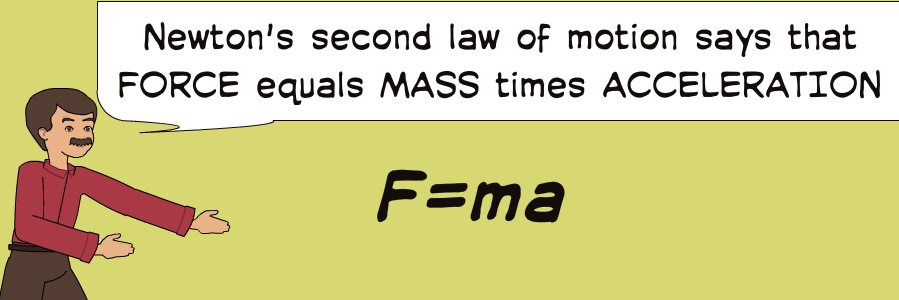
Newton’s second law of motion deals with the behaviour of objects on which all existing forces are not balanced.

According to this law,  the rate of change of momentum of a body is directly proportional to the external force applied on it and the change in momentum takes place in the direction of the force.


The force acting on a body is measured by the product of mass of the body and acceleration produced by the force acting on the body.

The second law of motion gives us a measure of the force.

The acceleration produced in the body depends upon the inertia of the body (i.e) greater the inertia, lesser the acceleration.

Newton's first law of motion

Newton’s first law of motion

It states that  every body continues  in its state of rest or of uniform motion along a straight line unless it is compelled by an external force to change that state. This law is based on Galileo’s law of inertia. 

Newton’s first law of motion deals with the basic property of matter called inertia and the definition of force.

 Inertia is that property of a body by virtue of which the body is unable to change its state by itself in the absence of external force.
The inertia is of three types 

(i) Inertia of rest 
It is the inability of the body to change its state of rest by itself.

Examples 
(a) A person standing in a bus falls backward when the bus suddenly starts moving. This is because, the person who is initially at rest continues to be at rest even after the bus has started moving. 
(b) When we hit a cardboard then the coin placed on it fall in the glass and do not move with the cardboard due to inertia of rest.
(c) When a carpet is beaten by a stick, the dust particles fall off vertically downwards once they are released and do not move along the carpet and fall off.


(ii) Inertia of motion
Inertia of motion is the inability of the body to change its state of motion by itself. 

Examples 
(a) When a passenger gets down from a moving bus, he falls down in the direction of the motion of the bus. 
(b) A passenger sitting in a moving car falls forward, when the car stops suddenly. 
(c) An athlete running in a race will continue to run even after reaching the finishing point. 


(iii) Inertia of direction 
It is the inability of the body to change its direction of motion by itself. 

Examples 
When a bus moving along a straight line takes a turn to the right, the passengers are thrown towards left. This is due to inertia which makes the passengers travel along the same straight line, even though the bus has turned towards the right.

This inability of a body to change by itself its state of rest or of uniform motion along a straight line or direction, is known as inertia. The inertia of a body is directly proportional to the mass of the body. 

From the first law, we infer that to change the state of rest or uniform motion, an external agency called, the force is required. 

Force is defined as that which when acting on a body changes or tends to change the state of rest or of uniform motion of the body along a straight line. A force is a push or pull upon an object, resulting the change of state of a body. Whenever there is an interaction between two objects, there is a force acting on each other. When the interaction ceases, the two objects no longer experience a force. Forces exist only as a result of an interaction.


Saturday, 25 July 2015

Significant figures

Significant figures

The digits which tell us the number of units we are reasonably sure of having counted in making a measurement are called significant figures. Or in other words,  the number of meaningful digits in a number is called the number of significant figures.

A choice of change of different units does not change the number of significant digits or figures in a measurement.

For example, 2.868 cm has four significant figures. But in different units, the same can be written as 0.02868 m or 28.68 mm or 28680 µm. All these numbers have the same four significant figures.

From the above example, we have the following rules.
i) All the non−zero digits in a number are significant.
ii) All the zeroes between two non−zeroes digits are significant, irrespective of the decimal point.
iii)  If the number is less than 1, the zeroes on the right of decimal point but to the left of the first non−zero digit are not significant. (In 0. 02868 the underlined zeroes are not significant).
iv)  The zeroes at the end without a decimal point are not significant. (In 23080  µm, the trailing zero is not significant).
v) The trailing zeroes in a number with a decimal point are significant. (The number 0.07100 has four significant digits).

Examples
i) 30700 has three significant figures.
ii) 132.73 has five significant figures.
iii) 0.00345 has three and
iv) 40.00 has four significant figures.


Atmospheric pressure

Atmospheric pressure

Atmospheric pressure is the pressure exerted by the weight of air in the atmosphere of Earth (or another planet).
You are currently being pressed on from above by 1,000 kilograms of air, the equivalent of the weight of a small car. This is because the Earth’s atmosphere is actually quite heavy, and humans stand at the bottom of an ocean of air carrying an atmospheric pressure of 14.7 pounds per square inch. We are adapted to withstand this pressure, and avoid being crushed by absorbing equally pressurized air into our bodies. However, impermeable objects such as plastic bottles released at altitude are crushed by the time they reach the Earth’s surface.


This plastic bottle was sealed at approximately 14,000 feet (4,300 m) altitude, and was crushed by the increase in atmospheric pressure —at 9,000 feet (2,700 m) and 1,000 feet (300 m)— as it was brought down towards sea level.


As altitude increases, there is less overlying atmospheric mass, so that atmospheric pressure decreases with increasing elevation.

Friday, 24 July 2015

Rules for writing SI units

Rules and conventions for writing SI units and their symbols


Basic forces of nature

Forces of nature

 Sir Issac Newton was the first one to give an exact definition for force.
“Force is the external agency applied on a body to change its state of rest and motion”.
There are four basic forces in nature. They are gravitational force, electromagnetic force, strong nuclear force and weak nuclear force.

Gravitational force 

It is the force between any two objects in the universe. It is an attractive force by virtue of their masses. By Newton’s law of gravitation, the gravitational force is directly proportional to the product of the masses and inversely proportional to the square of the distance between them. Gravitational force is the weakest force among the fundamental forces of nature but has the greatest large−scale impact on the universe. Unlike the other forces, gravity works universally on all matter and energy, and is universally attractive.

Weak nuclear force

Weak nuclear force is important in certain types of nuclear process such as  β-decay. This force is not as weak as the gravitational force.

Electromagnetic force

It is the force between charged particles such as the force between two electrons, or the force between two current carrying wires. It is attractive for unlike charges and repulsive for like charges. The electromagnetic force obeys inverse square law. It is very strong compared to the gravitational force. It is the combination of electrostatic and magnetic forces.

Strong nuclear force

It is the strongest of all the basic forces of nature. It, however, has the shortest range, of the order of 1 fermi metre. This force holds the protons and neutrons together in the nucleus of an atom.


Thursday, 23 July 2015

All objects fall at the same speed

ALL OBJECTS FALL AT THE SAME SPEED


If you are assuming that heavier objects fall faster than lighter ones—it sounds like common sense, and besides, you know for a fact that a bowling ball drops more quickly than a feather. And this is true, but it has nothing to do with gravity—the only reason this occurs is because the earth’s atmosphere provides resistance. In reality, as Galileo first realized about 400 years ago, gravity works the same on all objects, regardless of their mass. What this means is that if you repeated the feather/bowling ball experiment on the moon (which has no atmosphere), they would hit the ground at the exact same time.