Showing posts with label Physics. Show all posts

Wednesday, 4 October 2017

#गुरुत्वीय तरंगों का पता लगाने वालों को भौतिकी का #नोबेल पुरस्कार

प्रतिष्ठित पुरस्कार के लिए तीन अमेरिकी वैज्ञानिकों के नामों की घोषणा

स्टॉकहोम, रायटर : सापेक्षता का सिद्धांत देने वाले महान वैज्ञानिक अल्बर्ट आइंस्टीन के पूर्वानुमान के सौ साल बाद गुरुत्वीय तरंगों का पता लगाने वाले तीन अमेरिकी वैज्ञानिकों को साल 2017 का भौतिकी का नोबेल पुरस्कार दिया जाएगा। नोबेल पुरस्कार समिति ने मंगलवार को इस पुरस्कार के लिए रेनर विस, बैरी बैरिश और किप थोर्न के नामों की घोषणा की। गुरुत्वीय तरंगों को पहली बार सितंबर, 2015 में और चौथी बार इस साल 14 अगस्त को देखा गया था। इसकी मदद से सुदूर ब्रह्मांड में होने वाली गतिविधियों का पता लगाया जा सकेगा। 1तीनों खगोल वैज्ञानिकों को 11 लाख डॉलर (करीब 7.20 करोड़ रुपये) की इनामी राशि और प्रतीक चिह्न् दिए जाएंगे। पुरस्कार की आधी राशि रेनर विस को दी जाएगी। बाकी राशि थोर्न और बैरिश के बीच बांटी जाएगी। वैज्ञानिकों को उम्मीद है कि इसकी मदद से ब्लैक होल और न्यूट्रॉन तारों के बारे में और अधिक जानकारी जुटाई जा सकेगी। पांच दशकों से अनेक वैज्ञानिक और इंजीनियर गुरुत्वीय तंरगों की खोज में जुटे थे। नोबेल विजेताओं का चयन करने वाली समिति स्वीडिश रॉयल एकेडमी ऑफ साइंसेज के प्रमुख गोरन हैंसन ने बताया कि इस खोज ने दुनिया को हिला दिया था। तरंगों का पता लगाने के लिए अमेरिकी संस्था लेजर इंटरफेरोमीटर ग्रैविटेशनल वेव ऑब्जरवेटरी (लिगो) और इटली स्थित वगरे वेधशाला के वैज्ञानिक साथ मिलकर काम कर रहे हैं। थोर्न और विस ने कैलिफोर्निया इंस्टीट्यूट ऑफ टेक्नोलॉजी में लिगो की स्थापना की थी।स्टॉकहोम, रायटर : सापेक्षता का सिद्धांत

Thursday, 30 June 2016

A man is in a rowing boat floating on a lake, in the boat he has a brick. He throws the brick over the side of the boat so as it lands in the water. The brick sinks quickly. The question is, What happens to the water level in the lake? Does it rise, fall or stay the same?


When an object is floating be it because it is something less dense than water, say polystyrene, or because it is in a boat, say a brick and the whole boat is less dense than water, then it displaces in the water it's own mass. For example a 10 Kg lump of lead on a boat will force the boat to sink by a volume equivalent to 10Kg of water. Hence displacing 10Kg of water. Or indeed forcing the water level to raise by an amount equivalent to 10Kg of water. (Like when you get in the bath.)

When an object sinks in water it necessarily displaces it's own volume.

So when the brick is in the boat it is displacing it's own mass equivalence in water. When the brick is thrown over the side it is displacing it's own volume in water.

So which of these is greater?

Well we know the brick to be more dense than water because it sinks. So the volume of water equivalent to the mass of the brick is greater than the volume of the brick. And so less water is displaced after than before.

 Hence...
The Water Level Goes Down!!!!

If that is not clear then consider the following example: you need to know that 1 litre of water has a mass of 1Kg:-

Say the brick weighs 2Kg and is 1 litre in volume.

When the brick is in the boat it is forcing the water to be displaced by 2Kg or as we know 2ltr.

When the brick is over the side and sat on the bottom of the lake it is displacing just it's own volume or one litre.


<script data-ad-client="ca-pub-5661085866627725" async src="https://pagead2.googlesyndication.com/pagead/js/adsbygoogle.js"></script>

Saturday, 7 May 2016

Difference between mass and weight.


Mass is the measure of the amount of matter in a body. Mass is denoted using m or M.

Weight is the measure of the amount of force acting on a mass due to the acceleration due to gravity. Weight usually is denoted by W. Weight is mass multiplied by the acceleration of gravity.

Comparison of Mass and Weight

1)- Mass is a property of matter. The mass of an object is the same everywhere,
   - Weight depends on the effect of gravity. Weight varies according to location.

2)- Mass can never be zero.
    -Weight can be zero if no gravity acts upon an object, as at the center of earth(g = 0).

3)- Mass does not change according to location.
   - Weight increases or decreases with higher or lower gravity.

4)- Mass is a scalar quantity. It has magnitude.
   - Weight is a vector quantity. It has magnitude and is directed toward the center of the Earth or other gravity well.

5)- Mass may be measured using an ordinary balance.
   - Weight is measured using a spring balance.

6)- Mass usually is measured in grams and kilograms.
    - Weight often is measured in newtons, a unit of force.

Saturday, 19 September 2015

What is transformer? Definition & Working Principle of Transformer

What is transformer?


Definition & Working Principle of Transformer
Electrical power transformer is a static device which transforms electrical energy from one circuit to another without any direct electrical connection and with the help of mutual induction between two windings. It transforms power from one circuit to another without changing its frequency but may be in different voltage level.
Working Principle of Transformer
The working principle of transformer is very simple. It depends upon Faraday's law of electromagnetic induction. Actually, mutual induction between two or more winding is responsible for transformation action in an electrical transformer.
Faraday's Laws of Electromagnetic Induction
According to these Faraday's laws,
"Rate of change of flux linkage with respect to time is directly proportional to the induced EMF in a conductor or coil".
Basic Theory of Transformer
Say you have one winding which is supplied by an alternating electrical source. The alternating  current  through the winding produces a continually changing flux or alternating flux that surrounds the winding. If any other winding is brought nearer to the previous one, obviously some portion of this flux will link with the second. As this flux is continually changing in its amplitude and direction, there must be a change in flux linkage in the second winding or coil.
According to Faraday's law of electromagnetic induction, there must be an EMF induced in the second. If the circuit of the later winding is closed, there must be an  current flowing through it. This is the simplest form of electrical power transformer and this is the most basic of working principle of transformer.
For better understanding, we are trying to repeat the above explanation in a more brief way here. Whenever we apply alternating  current  to an electric coil, there will be an alternating flux surrounding that coil. Now if we bring another coil near the first one, there will be an alternating flux linkage with that second coil. As the flux is alternating, there will be obviously a rate of change in flux linkage with respect to time in the second coil. Naturally emf will be induced in it as per Faraday's law of electromagnetic induction. This is the most basic concept of the theory of transformer.
The winding which takes electrical power from the source, is generally known as primary winding of transformer. Here in our above example it is first winding.

The winding which gives the desired output voltage due to mutual induction in the transformer, is commonly known as secondary winding of transformer. Here in our example it is second winding.
The above mentioned form of transformer is theoretically possible but not practically, because in open air very tiny portion of the flux of the first winding will link with second; so the  current that flows through the closed circuit of later, will be so small in amount that it will be difficult to measure.
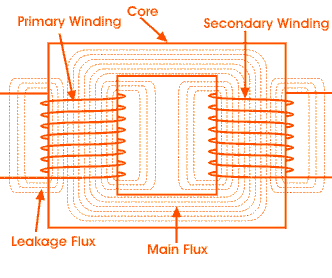
The rate of change of flux linkage depends upon the amount of linked flux with the second winding. So, it is desired to be linked to almost all flux of primary winding to the secondary winding. This is effectively and efficiently done by placing one low reluctance path common to both of the winding. This low reluctance path is core of transformer, through which maximum number of flux produced by the primary is passed through and linked with the secondary winding. This is the most basic theory of transformer.
Main Constructional Parts of Transformer
The three main parts of a transformer are,
Primary Winding of transformer - which produces magnetic flux when it is connected to electrical source.
Magnetic Core of transformer - the magnetic flux produced by the primary winding, that will pass through this low reluctance path linked with secondary winding and create a closed magnetic circuit.
Secondary Winding of transformer - the flux, produced by primary winding, passes through the core, will link with the secondary winding. This winding also wounds on the same core and gives the desired output of the transformer.

Source:-
http://img.directindustry.com/images_di/photo-g/electric-arc-furnace-transformer-112419-3725717.jpg

Saturday, 25 July 2015

Do physics proves the existence of ghosts..

Physics Proves the Existence of Ghosts?


Do Einstein’s Laws Prove Ghosts Exist?

… Despite years of efforts by ghost hunters on TV and in real life, we still do not have good proof that ghosts are real. Many ghost hunters believe that strong support for the existence of ghosts can be found in modern physics. Specifically, that Albert Einstein, one of the greatest scientific minds of all time, offered a scientific basis for the reality of ghosts. …

Now hold on a minute.  As we’ve seen before, it is not uncommon for pseudoscientists and cranks of all kinds to try glomming onto Einstein’s coat-tails as one of the most well-known and respected scientists of the 20th century as a way of trying to gain traction for their ideas.  It is as if they think that by simply invoking Einstein’s name and theories, despite the fact that they have no real understanding of those theories, that it will somehow, magically make them correct.  Of course, this simply displays a fundamental flaw in the thinking of ghost-hunters, because it shows they have no real knowledge of how science (much less physics) works.

Specifically, in this case the ghost-hunters are claiming that Einstein’s theory of relativity “proves” the existence of ghosts:

… For example, ghost researcher John Kachuba, in his book “Ghosthunters” (2007, New Page Books), writes, “Einstein proved that all the energy of the universe is constant and that it can neither be created nor destroyed. … So what happens to that energy when we die? If it cannot be destroyed, it must then, according to Dr. Einstein, be transformed into another form of energy. What is that new energy? … Could we call that new creation a ghost?”

This idea shows up — and is presented as evidence for ghosts — on virtually all ghost-themed websites as well. For example, a group called Tri County Paranormal states, “Albert Einstein said that energy cannot be created or destroyed, it can only change from one form to another. When we are alive, we have electrical energy in our bodies. … What happens to the electricity that was in our body, causing our heart to beat and making our breathing possible? There is no easy answer to that.” … [emphasis added]

Actually, the answer is pretty easy, as long as you understand how energy is related to matter as outlined in Einstein’s theory.  It can all be summed up in what is probably the most well-known, but one of the least understood, equations in all of science…

E = mc^2

… also known as the mass-energy equivalence formula. The equation basically states that matter is a form of energy, and it quantifies the amount of energy bound up in a certain amount of matter (if you want to calculate it, E stands for energy in Joules, m is mass in kilograms, and c is the speed of light – equal to about 300,000,000 meters/second).  We know this formula is an accurate representation of reality because we have performed numerous experiments where matter is annihilated into pure energy (and vice versa), which confirms this equation.  Not to mention, we have technology – such as nuclear power plants and PET scans – which operates based upon the physics summed up in this equation.

So when the ghost-hunters are talking about the “energy” of a person going off into some ethereal realm to form a ghost, I think they are simply making stuff up and abusing Einstein’s famous equation.  That’s because when someone dies, the matter (i.e. energy) forming the person’s body is simply redistributed when they decay away into the environment.  I like the way that Ben Radford puts it:

… After a person dies, the energy in his or her body goes where all organisms’ energy goes after death: into the environment. When a human dies, the energy stored in his or her body is released in the form of heat, and transferred into the animals that eat us (i.e., wild animals if we are left unburied, or worms and bacteria if we are interred), and the plants that absorb us. If we are cremated, the energy in our bodies is released in the form of heat and light.

When we eat dead plants and animals, we are consuming their energy and converting it for our own use. Food is metabolized when digested, and chemical reactions release the energy the animal needs to live, move, reproduce, etc. That energy does not exist in the form of a glowing, ghostly ball of electromagnetic energy, but rather in the form of heat and chemical energy.

Many ghost hunters say they can detect the electric fields created by ghosts. And while it’s true that the metabolic processes of humans and other organisms actually do generate very low-level electrical currents, these are no longer generated once the organism dies. Because the source of the energy stops, the electrical current stops — just as a light bulb turns off when you switch off the electricity running to it. …

Let’s think about it this way: if ghost-hunters were correct that a spiritual realm indeed exists and is populated by the “energy” given off by someone when they die (that is, ghosts being a manifestation of this “energy”), then this poses some pretty sticky questions for the ghost-hunters.  First, how much “energy” does it take to make a ghost?  And, in relation to this question, exactly how much matter from a dead body must be somehow annihilated to form this mysterious “ghost energy”, since we know that mass and energy are interchangeable?  And if, by some miracle, ghost-hunters actually are able to somehow quantify either of the above questions (they haven’t), do they have any way to empirically prove that 1) such a transfer of matter into pure energy indeed takes place and 2) provide an explanation for a physical mechanism which would facilitate such an transfer?

Not to mention, there are other problems.  For instance, if people keep dying and this keeps on generating ghosts and disembodied spirits formed out of “energy” which previously existed in the form of living beings, then eventually would we not have some kind of massive “energy crisis” with too much energy supposedly filling up the spiritual realm at the expense of the physical world?  And if this spirit world really is populated by “ghost energy”, wouldn’t all of the supposed interactions between ghosts and the physical world be generating a helluva lot of entropy, speeding up the onset of the heat death of the universe?!  Wow, and I thought dealing with the future production and distribution of oil was problematic!

In conclusion, it seems clear to me that when ghost-hunters try to talk physics, they just end up looking stupid.  They have nothing even closely resembling a coherent theory, they have no consistent protocols, they have no solid definitions (just try asking one of them to provide a clear-cut definition of a “ghost”!)  What they do have is over-active imaginations and over-blown stories which they think is all that is necessary to do science.  And science just doesn’t work that way.


Source:-https://skepticalteacher.wordpress.com/2011/11/24/physics-proves-the-existence-of-ghosts/

Friday, 24 July 2015

Basic forces of nature

Forces of nature

 Sir Issac Newton was the first one to give an exact definition for force.
“Force is the external agency applied on a body to change its state of rest and motion”.
There are four basic forces in nature. They are gravitational force, electromagnetic force, strong nuclear force and weak nuclear force.

Gravitational force 

It is the force between any two objects in the universe. It is an attractive force by virtue of their masses. By Newton’s law of gravitation, the gravitational force is directly proportional to the product of the masses and inversely proportional to the square of the distance between them. Gravitational force is the weakest force among the fundamental forces of nature but has the greatest large−scale impact on the universe. Unlike the other forces, gravity works universally on all matter and energy, and is universally attractive.

Weak nuclear force

Weak nuclear force is important in certain types of nuclear process such as  β-decay. This force is not as weak as the gravitational force.

Electromagnetic force

It is the force between charged particles such as the force between two electrons, or the force between two current carrying wires. It is attractive for unlike charges and repulsive for like charges. The electromagnetic force obeys inverse square law. It is very strong compared to the gravitational force. It is the combination of electrostatic and magnetic forces.

Strong nuclear force

It is the strongest of all the basic forces of nature. It, however, has the shortest range, of the order of 1 fermi metre. This force holds the protons and neutrons together in the nucleus of an atom.